Build yours

How to build an AI second brain: the order I got wrong
The last chapter was the review. This one is what I would do differently.
I did not build my brain in the order I am about to give you.
I built pieces as the pain arrived. A glossary because my transcripts kept turning Monday.com into "muddy dot com". A critic so nothing left without a second pair of eyes. A ladder so one client's habit could never quietly become a rule. Each piece was right. The sequence was not.
The worst of it was measurement. I never gave it a proper place, and it is still the weakest layer I have. Which means for a long stretch I had a system that was clearly busy and no honest way to say whether it was getting better... or just getting longer.
If I started again tomorrow, I would build the same parts in a different order, and I would start measuring on the first day, not the last.
So that is what this chapter is. Not my system. The onboarding plan for your own hire, in the order that would have saved me the most time, with the parts you can skip until you need them.
The idea
You don't need my system. You need your own. Build yours.
Every repo in this guide stands alone. You can add any one of them to a brain you already have, whether that is a folder of markdown, an Obsidian vault or a Notion export. The order below is a suggestion for someone starting from nothing. Skip a step the moment it does not match your work.
How it works
Six steps. Each one is a room you add when the last one starts to feel cramped. Effort figures are my rough estimates for one person working alone, not measurements.
  Ch.0          brain-starter     learning-glossary    the-critic       evidence-ladder     brain-map
  basic brain ─► the house     ─► (if you record   ─► before anything ─► once sources    ─► past ~200
  (hub page)     rules + logs      calls)              goes external     repeat              files
   │               │                 │                   │                 │                   │
   an afternoon    a weekend         an afternoon        an afternoon      a weekend           an hour
   (est.)          (est.)            (est.)              (est.)            (est.)              (est.)

  MEASURE FROM DAY ONE ───────────────────────────────────────────────────────────────────────────►
  usage · edit rate · critic verdicts · demotions · runs logged with who ran them
Step 1. The basic brain. Start with Chapter 0, the starter guide on the hub page. A folder of plain markdown files, one place for raw notes and one for what you have worked out from them, and an AI that reads them before it answers. What you get: an assistant that stops starting from zero. Effort: an afternoon (estimate). Repo: none yet.
Step 2. The house. Add brain-starter. This is where the brain gets rules: what the AI reads first, which file wins when two disagree, what it may change and what it may only suggest, and a log line for every run. What you get: a brain that behaves the same way every session and can show its work. Effort: a weekend to fill in properly (estimate). Repo: brain-starter.
Step 3. The glossary, if you record calls. Add learning-glossary. It cleans your transcripts and learns your words: names it keeps mishearing, your jargon, the phrases where you switch languages. It trusts nothing it has seen only once. What you get: transcripts you can actually feed back into the brain. Effort: an afternoon to set up (estimate), then it grows with every call. Skip it if you do not record calls. Repo: learning-glossary.
Step 4. The critic, before anything goes external. Add the-critic before the first draft leaves your desk for a client or the public. A separate reviewer whose job is to find reasons a draft will fail, with three possible verdicts: ship, rewrite, escalate. Add the clearance list from Chapter 9 if you work with clients. What you get: a second pair of eyes that is not trying to please you. Effort: an afternoon (estimate). Repo: the-critic.
Step 5. The ladder, once you have repeated sources. Add evidence-ladder when the same pattern starts showing up from different places: different clients, different campaigns, different calls. Patterns climb from watch to suggest to auto-apply only as separate sources agree, and fall back down when evidence contradicts them. What you get: rules you can trust because you can see why they are believed. Effort: a weekend, mostly deciding what counts as a separate source (estimate). Repo: evidence-ladder.
Step 6. The map, past about 200 files. Add brain-map when you can no longer hold the brain in your head. What you get: an answer to "what does changing this ripple into?", plus a list of stale and broken links before an agent trusts them. Effort: an hour to install and point at your folder (estimate). Repo: brain-map.
What to measure from day one
This is the part I would not skip, at any step.
Usage. Do you actually use what the brain produces? A draft you never open is a cost, not an output. Count what gets used.
Edit rate. When you do use it, how much do you change? A falling edit rate is the nearest thing to proof that the brain is learning you. A rising one is an early warning.
The honesty signals. Three numbers tell you whether the system is telling the truth about itself. How often the critic says rewrite or escalate (a critic that always says ship is asleep). How often a rule gets demoted (a ladder that only climbs is not checking). And whether every run is logged with who ran it. "If the run wasn't logged, it didn't happen."
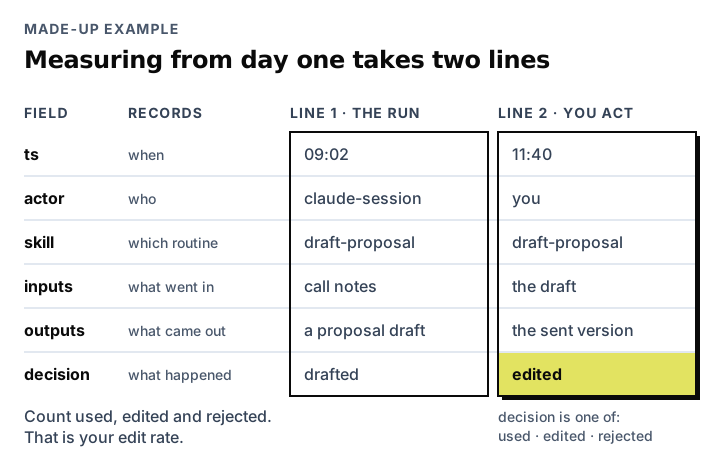
None of these needs a dashboard on day one. A line in a log file per run is enough to start.
What I learned the hard way
Every rule needs a check. Whatever order you build in, every rule you write needs something that checks it. Otherwise it drifts, quietly, and you find out late.
The system once refused its own growth, and it was right. When two new skills were proposed, its rule against skill explosion stopped them, and the work became two sections of one daily file instead. Build that brake in early. A brain that grows a new tool for every edge case becomes a brain nobody can read.
Test before you finalise. One skill's first test run found four gaps in a single pass, all fixed before it was finalised. Run every new piece once, on real work, before you start trusting it.
Try it
The Compounding Brain: all five repos
- brain-starterthe house: rules, logs and skills that write skills.Open the repo
- learning-glossarylearns your words from your calls.Open the repo
- the-criticchecks every draft before it leaves.Open the repo
- evidence-ladderturns repeated patterns into rules only when the evidence agrees.Open the repo
- brain-mapshows what a change ripples into.Open the repo
The honest limit
The effort figures above are my estimates, not timed builds, and yours will vary with how much you already have. The order is the one I would follow now, after building it the long way once. It has not yet been tested by anyone starting from zero with it in hand... which is part of why Brain Builders exists. If you build an AI second brain with this order, tell me where it breaks.
Read this next
Chapter 1 started with a hire who forgot everything overnight. Give yours a cabinet and a written briefing, and tomorrow morning it starts on day two.
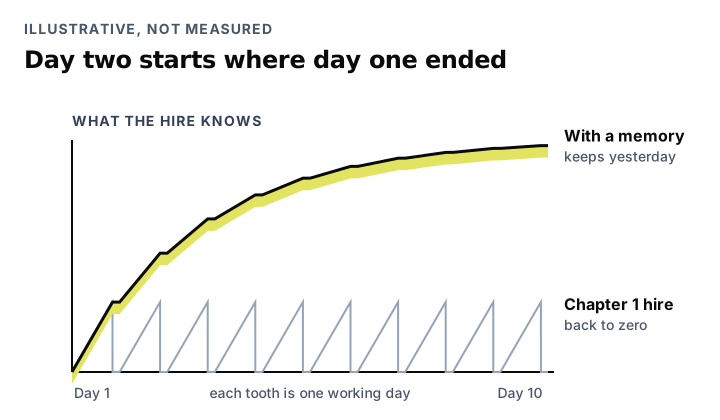
That is the last chapter... go back to the hub and pick the first step. Or reread What still breaks before you start, so you know where to look first.
Building one of these? You don't have to do it alone.