The night shift

Two interviews that never arrived
By now the hire had a desk, a cabinet and a written briefing waiting every morning. The cabinet looked full. It wasn't.
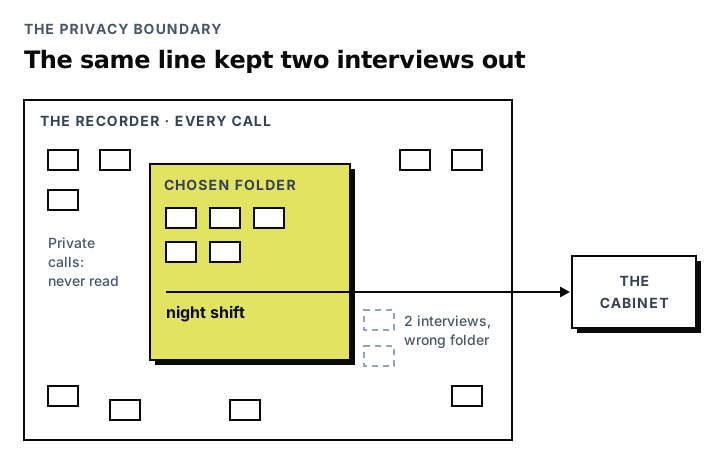
Early on, I recorded two interviews for my consulting work. The recorder caught every word. But the recordings ended up in a different folder from the one my capture reads.
That folder rule is deliberate. The capture that feeds my brain only looks inside one folder I choose. A call anywhere else is never touched, never read, never copied. It's how private calls stay private.
So the capture never saw those two interviews. It didn't fail. It didn't warn anyone. From its side, they simply didn't exist. And from my side, nothing looked missing... the brain kept answering from everything else it had.
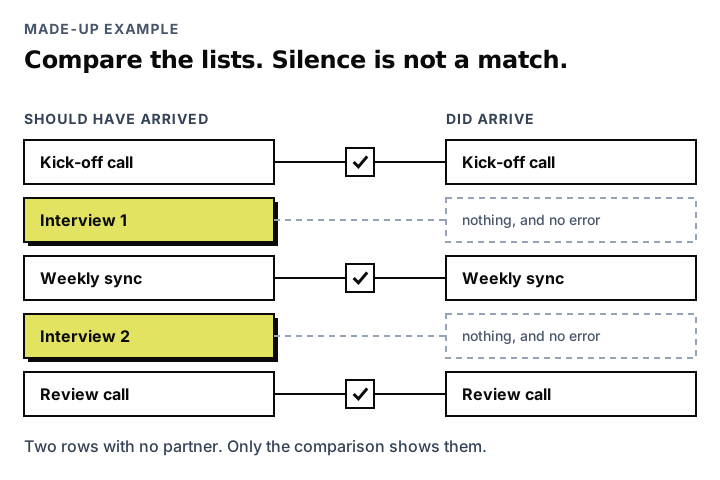
Nobody noticed until the meeting index was checked against what should have been in it.
A cabinet only holds what someone puts in it. And the thing putting it in only sees what's in front of it. Capture isn't plumbing you set up once and forget. It's a job. Somebody has to walk the building, look at every desk, and file what got left there.
I call that job the night shift.
The idea
A cabinet only holds what goes in, so something has to walk the building and file what got left on desks.
Capture has two jobs. The first is the past: pour in everything you already have, once. The second is the future: every day, keep filing what's new. It's easy to do the first and skip the second. Then the most valuable half of the business, the half that lives in calls and inboxes, never makes it in.
How it works
Think about everywhere work gets done, or ends up. For me that's calls, the inbox, the calendar and a few shared drives. Calls are the richest. More gets decided out loud than ever gets written down.
Here's what happens to a call.
Only from the folder I chose. My call recorder keeps everything. The night shift doesn't. It only looks inside one folder that I put calls into on purpose. A call that isn't in that folder is never touched, never read, never copied. Privacy is decided by where I put things, not by hoping the AI is discreet.
I start the shift. Capture from calls is triggered by hand, by design. To pull anything, a person has to complete the sign-in. The system can't quietly go and fetch my calls at 3 a.m. on its own. One command does the whole catch-up, but a human runs it.
Word for word, once. Each call is copied exactly as it was recorded: the transcript, the summary, the details. Nothing is cleaned at this stage. Then it's ticked off on a "seen it" list, so the same call is never pulled twice.
Then it's cleaned. Only after it's safely filed does the call get cleaned up and turned into a readable note. That cleaning step is where the glossary lives, and it gets its own chapter next.
   calls        inbox        calendar       drives
     │            │             │             │
     └──── only from the folders I chose ─────┘
                       │
             a person signs in and runs it
                       │
                       ▼
           ┌───────────────────────┐
           │ COPY, word for word   │  nothing cleaned yet
           └───────────┬───────────┘
                       ▼
           ┌───────────────────────┐
           │ "SEEN IT" LIST        │  never pulled twice
           └───────────┬───────────┘
                       ▼
           ┌───────────────────────┐
           │ CLEAN WITH GLOSSARY   │  → filed in the cabinet
           └───────────────────────┘
What I learned the hard way
A privacy boundary hides mistakes too. Reading only one folder is what keeps private calls out. It's also what kept two real interviews out. The boundary can't tell a private call from a misfiled one, so it treats them the same.
Silence is not the same as nothing missing. Capture that misses a call doesn't throw an error. The only way to find the gap is to check the list of what came in against what should have. That check is how the two interviews surfaced.
Try it
learning-glossary... capture adapters that stage your calls word for word, once, from the folder you choose, plus the glossary that cleans them.Open the repoThe honest limit
The night shift doesn't run while I sleep. It's a shift I start, because a person has to sign in, and I chose that over silent automation. That means if I don't run it, nothing gets filed. And because it only reads the folder I chose, a call filed anywhere else stays invisible until someone checks the index.
Read this next
So the calls started arriving, word for word. Which meant every word the transcript got wrong arrived too.
Next... The glossary that learns my words: what happens when half your calls switch languages mid-sentence.
Related: What still breaks, for the full list of what's manual today.
Building one of these? You don't have to do it alone.