The filing cabinet

What an AI second brain is made of
The hire from Chapter 1 had no desk. Every morning it arrived empty-handed, and I handed it the whole business again, out loud.
There are two easy answers to that. The traditional one is a filing cabinet: keep everything, in folders, forever. It stores. It never learns. The modern one is a fast assistant that fetches the right file the moment you ask. Plenty of AI memory tools sell exactly that. Search. Retrieval. Speed.
I thought speed was the answer. But a fetcher can only fetch what's written down, and only in the shape it was filed. If the same fact lives in three places with three versions, it brings back whichever one it hits first... faster.
So my first real decision wasn't how to search. It was what the cabinet is made of.
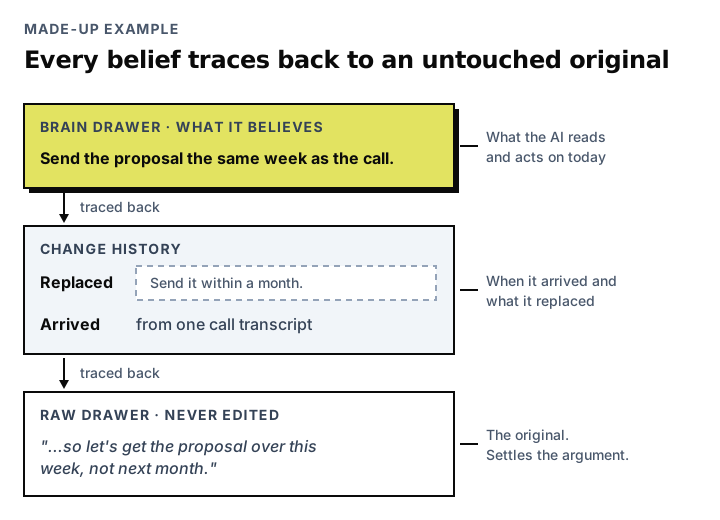
I chose plain text files. Every change is versioned. Every change can be compared, line by line, with the one before. And the history is the provenance: for any claim the brain makes, I can see when it arrived and what it replaced.
The starter kit I give away opens with the rule that came out of that choice: "Raw is sacred. The brain is alive." The originals are never edited. What the system believes is allowed to change, and every change leaves a trail back to the originals.
The fetching was never the hard part. The real work happens before anyone asks anything: deciding how the cabinet is organised.
The idea
Speed is useless if the cabinet is chaos. Structure is the real work.
It's tempting to stop at the cabinet: build it, call it a second brain, and watch it never get any smarter. The cabinet isn't the whole system. But everything else in this guide sits on top of it, so it has to be right.
How it works
My cabinet is a folder of plain text files. Nothing clever. That turns out to matter more than anything clever would.
Plain files. Every note is a file I can open in any editor. Every change has a history, so I can see what changed, when, and who changed it. Nothing is locked inside one company's app. If a tool disappears tomorrow, the cabinet doesn't.
Originals kept apart from what's believed. There are two drawers. One holds the raw material: transcripts, exports, notes exactly as they arrived. Nothing in it is ever edited. The other holds what the system actually believes, after it's been checked and sourced. When something in the second drawer looks wrong, I can always trace it back to the first.
Three kinds of memory. Facts are read-only: what happened, what was decided. Behaviour is my feedback, like "no em-dashes, ever", and the AI may update it when I correct it. Procedures are the routines it follows for each job. Keeping them apart means a correction to how it writes never quietly changes what it thinks is true.
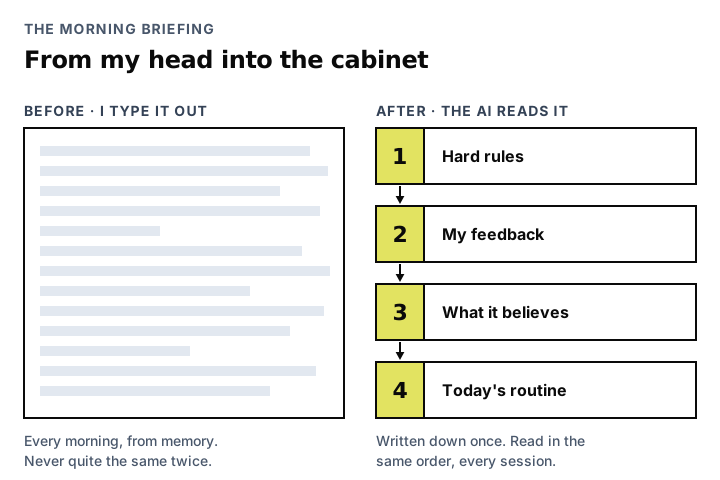
A load order. Every session, the AI reads the same things in the same order: the hard rules first, then my feedback, then what it believes, then the routine for today's task. The hire still forgets overnight. But now the morning briefing is written down, and it's the same every time.
A run log. Every time it does a job, it writes one line: what it did, with what, and who asked.
 ┌──────────────────── THE FILING CABINET ────────────────────┐
 │                                                            │
 │   RAW DRAWER         originals, exactly as they arrived    │
 │        │             never edited                          │
 │        ▼  checked, cleaned, sourced                        │
 │   BRAIN DRAWER       what the system believes              │
 │                                                            │
 │   MY FEEDBACK        how I want it to behave               │
 │   ROUTINES           how it does each job                  │
 │   RUN LOG            every run, and who ran it             │
 │                                                            │
 └────────────────────────────────────────────────────────────┘

 Every morning:  hard rules → my feedback → what it believes → today's routine
What I learned the hard way
Keep the originals untouchable. When something in the brain looks wrong, the only way to settle it is to go back to the source exactly as it arrived. That only works if nothing ever edited it. "Raw is sacred" is the rule. The trail back is the reason.
If the run wasn't logged, it didn't happen. Before the run log, I couldn't answer simple questions. Did it use last week's notes or this week's? Who asked for that draft? Now every run leaves a line with a name on it.
Try it
brain-starter... the house. A plain-file brain with three kinds of memory, a load order and a run log, ready in a minute.Open the repoThe honest limit
Plain files have no search index, so past a certain size the AI has to be told where to look. Permissions are coarse: a person can read a folder or they can't. And the cabinet holds what was true when it was filed... it has no live view of what's happening in your business right now. That's the trade I made for an AI second brain I can read, diff and trust.
Read this next
The cabinet was built. What I had not checked was everything that never reached a drawer.
Next... The night shift: a cabinet only holds what someone puts in it.
Related: One brain, many doors, for who gets to open which drawer.
Building one of these? You don't have to do it alone.